

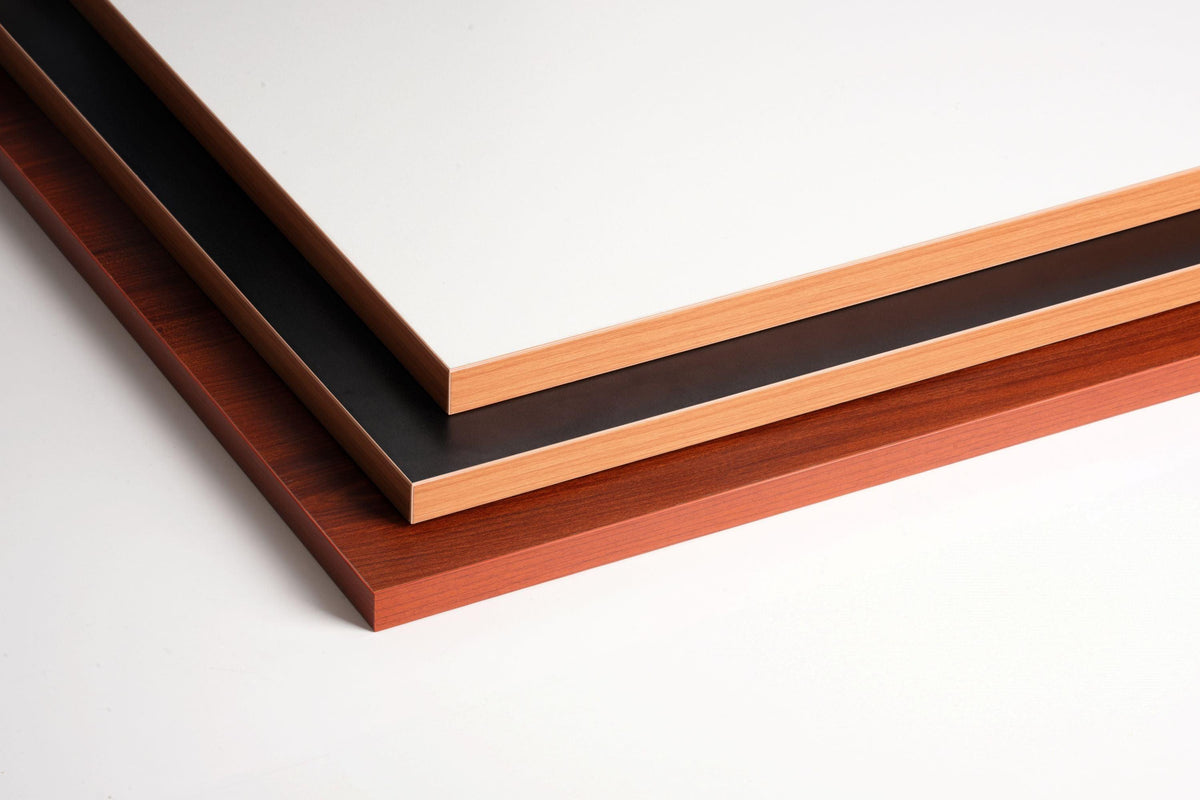
Two highly versatile desk models from HyperWork, the Atlas standing desk and the Core Desk module desk, both use premium green-core MDF industrial wood for their tabletops.
Is an impressively designed, luxurious, and harmonious desk that fits various office concepts the only factor furniture users care about? After a long period of observation and consultation, HyperWork noticed that many customers, before experiencing the Core Desk or Atlas desk, had questions about the tabletop's quality, including: What is its load capacity? Does the tabletop maintain quality after repeated assembly and disassembly? Do drilling holes and screwing affect the structure? After a period of use, does the tabletop sag or become moldy?
To ensure durability, aesthetics, and high applicability for customers over a long period, HyperWork is committed to strictly supervising the MDF wood production process and quality control to meet international industrial standards.
So, what are the production indicators for MDF wood, and which standards have HyperWork's MDF wood products met or exceeded in its furniture? Read the article below to learn more and feel confident about the quality of HyperWork desks.

First, let's learn some basic information about MDF (Medium Density Fiberboard). MDF is a common material used in many construction projects in daily life.
It is considered a material with a long lifespan and high durability, as it resists warping, shrinking, and termite damage across various weather conditions, especially when compared to natural wood.
Not only that, MDF wood is also an environmentally friendly solution, with a smooth surface that facilitates construction and can be easily combined with materials like Poly, acrylic, melamine, and laminate for painting, gluing, printing, etc., thereby significantly optimizing costs for users.

As a common material, manufacturers certainly need to rely on international standards to assess whether an MDF wood product meets quality requirements. Specifically:

1. Density
MDF density refers to the mass per unit volume of the MDF board (unit kg/m³). High-density MDF is typically sturdier and more durable.
The density of MDF boards typically ranges from 650 - 710 kg/m³ based on EN 323:1993 standards. This value helps ensure that MDF has the necessary stiffness, durability, and stability for furniture and construction applications.
For HyperWork's MDF wood products, this density figure is 670 kg/m³.

2. Static Bending Strength
Static bending strength measures the maximum pressure an MDF board can withstand when bent until it breaks (unit MPa - megapascal or N/m² - newton per square meter). If this index does not meet the standard, it means the mechanical strength of the MDF board is not guaranteed, easily leading to cracks and damage, posing risks during use.

The standard static bending strength is >=27 N/mm². This figure, according to EN 310: 1993, ensures that the MDF product has good load-bearing capacity for industrial requirements and practical applications demanding stiffness and durability.
For HyperWork's MDF wood products, the static bending strength reaches 31 N/mm², meeting the aforementioned standard.
3. Modulus of Elasticity
The modulus of elasticity refers to the MDF board's ability to resist deformation when a force is applied. An MDF board with poor elasticity will sag when suddenly subjected to a heavy load and will not be able to return to its original shape.
A modulus of elasticity of >=2,700 N/mm² for MDF boards, according to EN 310: 1993, ensures that the product meets the mechanical and physical requirements for industrial and interior design applications.
For HyperWork's MDF wood products, the modulus of elasticity reaches 2,882 N/mm², exceeding the EN 310: 1993 standard.
4. Internal Bond
When measuring the bond between particles in an MDF board, the concept of internal bond strength is used. This index reflects the MDF board's ability to withstand impact forces. If the internal bond is low, manufacturers may even face difficulties in production, such as during the surface lamination process. Therefore, a standard internal bond will limit issues like poor screw retention and easy displacement after assembly or moving furniture products.
An internal bond of >=0.80 N/mm² for MDF boards, according to EN 319: 1993, ensures product durability during use.
For HyperWork's MDF wood products, this index reaches 0.89 N/mm², again exceeding the standard.
5. Moisture Content
Moisture content refers to the percentage of water by weight in an MDF board. Optimal moisture content limits deformation, damage, and shrinkage of the product after long-term use, ensuring stability and durability.
According to EN 322: 1993, MDF moisture content can range from 5-10%.
For HyperWork's MDF wood products, the moisture content is approximately 6.54%, which is within the permissible range.

6. Thickness Swelling
To test for thickness swelling, manufacturers typically immerse MDF boards in water for 24 hours to record the results. Thickness swelling refers to the increase in MDF's dimensions when it absorbs water. High swelling can lead to blistering and warping of edges, especially in humid tropical monsoon climates like Vietnam.
A swelling rate of <=12% is permissible for MDF wood, according to EN 317: 1993. Pre-steaming wood raw materials can be considered a common method to reduce the percentage of MDF wood swelling.
For HyperWork's MDF wood tabletops, this index is around 10.75%, meeting the standard to ensure limited deformation when exposed to high humidity.
Check out 3 green-core MDF wood tabletop designs from HyperWork, used for both the Core Desk module desk and the Atlas standing desk. Not only do they impress with neutral colors suitable for various interiors and setup styles, HyperWork tabletops also stand out with Light Brown edge banding and wood grain edge banding in the same color as the tabletop, catering to user preferences.







Leave a comment
This site is protected by hCaptcha and the hCaptcha Privacy Policy and Terms of Service apply.