
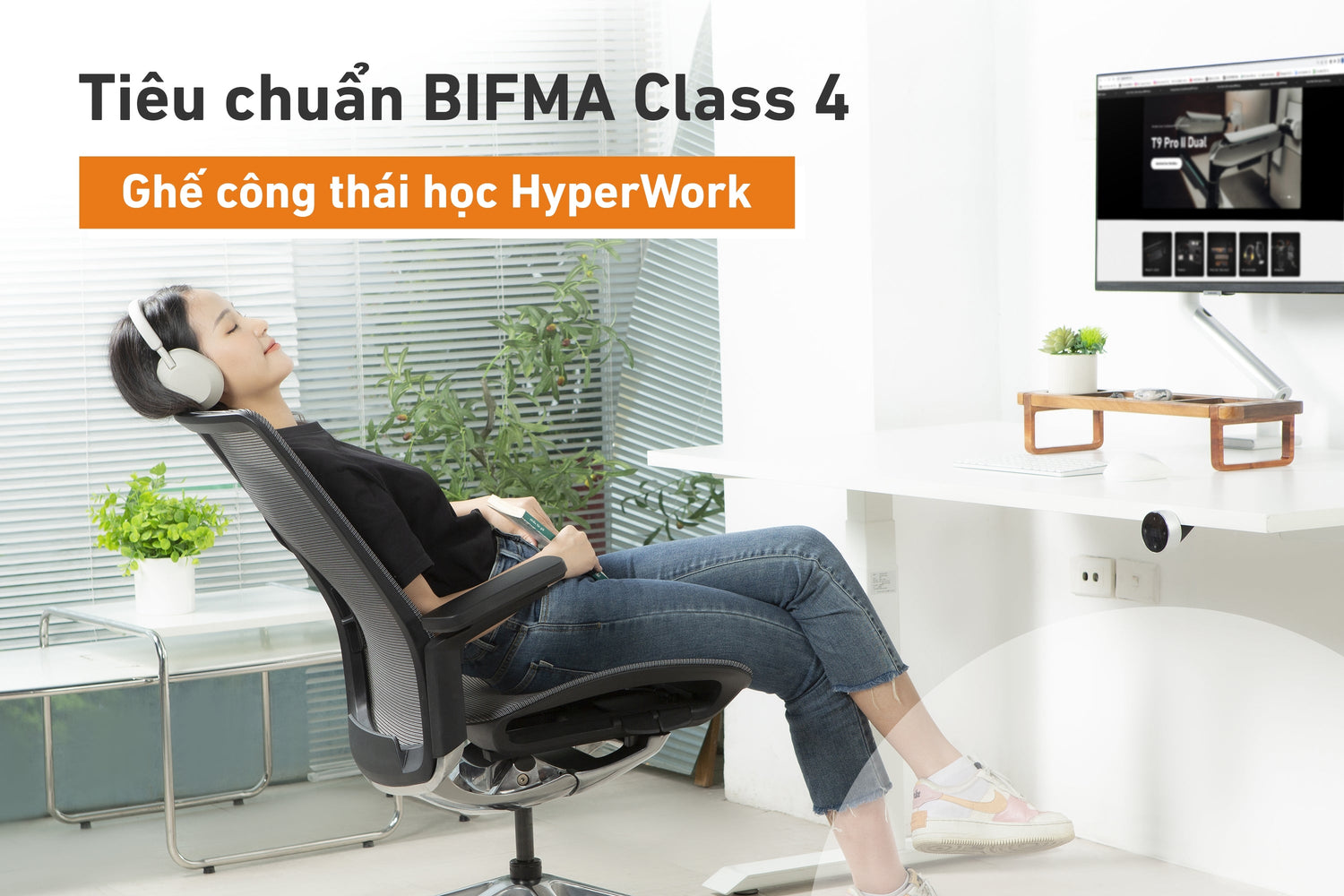
All HyperWork ergonomic chair models are certified to meet BIFMA Piston Class 4 standards after undergoing numerous rigorous tests and trials.
The BIFMA certification standard is considered a guarantee of the quality, safety, and durability of furniture products.
BIFMA stands for The Business and Institutional Furniture Manufacturer’s Association. BIFMA establishes technical requirements (structure, features, performance, safety, and durability) for furniture items such as chairs, desks, cabinets, etc., which are widely applied globally.
Although basic tests under the BIFMA standard can apply to all piston types (Class 3 and Class 4 – common piston types for ergonomic chairs), each Class has specific requirements for load capacity and testing intensity.
Chairs using Class 4 pistons must undergo tests with higher load capacities to meet better durability requirements.
Tests under the BIFMA Piston Class 4 standard include:

1. Functional Load Test
- Purpose: This test ensures that the chair's functions operate smoothly and accurately under actual load conditions, providing an overall assessment of the chair's functional capabilities.
- Standard:
Manufacturers must test functions such as height adjustment (ensuring the chair maintains its position), recline support (ensuring the chair does not slip or change recline position), and recline lock (ensuring the locking mechanism does not jam or malfunction).
The load applied for this test is 150 kg. The cycle count is approximately 10,000-20,000 cycles (for height adjustment) and 10,000-30,000 cycles (for recline).

2. Proof Load Test
- Purpose: This test aims to determine the chair's load-bearing capacity under extreme loads without severe deformation or structural failure.
- Standard
The chair must withstand a load higher than the maximum anticipated level. Manufacturers must maintain this load for 1-2 hours to simulate real-world conditions where the chair might experience such extreme loads.
3. Fatigue Test
- Purpose: During the fatigue test, manufacturers must demonstrate that their chair can withstand prolonged and continuous use under real-world conditions without failure or degradation of features. Components such as the lift piston and backrest are emphasized to ensure no loss of functionality.
- Standard:
For Class 4 pistons, the simulated load is typically 150 kg. Manufacturers perform 60,000 - 100,000 cycles, with each cycle including one sit and one stand. Additionally, the cycle speed must be maintained at 10-15 cycles/minute.

4. Static Load Test
- Purpose: With the static load test, manufacturers must ensure their chair can withstand the maximum load without structural failure or functional degradation (simulating continuous heavy use of the chair).
- Standard:
The chair must continuously withstand a maximum load of 150 kg for a specified period, usually 1-2 hours, without deformation or damage.
Manufacturers must place a standard weight or a force-generating device (corresponding to the maximum load) on the seat pan, backrest, or other critical parts of the chair. If the chair frame, piston, backrest, armrests, and overall chair remain stable after the test period, the chair passes this test.
5. Dynamic Load Test
- Purpose: The dynamic load test assesses whether the chair can withstand the impact force from continuous and sudden use (simulating a user repeatedly sitting down and standing up). If no structural or functional issues occur, the chair passes this test.
- Standard:
The chair must withstand a load of 150 kg with sitting and standing cycles (from 60,000 to 100,000) at a speed of 10-15 times/day.
However, instead of taking many years to complete this test by calculation, modern durability testing equipment using sensors can simulate thousands of cycles per hour, significantly shortening the testing time.

Ergonomic chairs that undergo BIFMA standard certification can ensure:
- Durability and stability over time
- User safety (within the manufacturer's recommended load capacity)
- Flexibility (easy adjustment of features like recline, height, armrests, and headrest to suit the user's body shape and needs for work, entertainment, and relaxation)
- Material quality (meets quality standards, durable, non-toxic)
- Structural and design quality (sturdy structure, reasonable design)



Leave a comment
This site is protected by hCaptcha and the hCaptcha Privacy Policy and Terms of Service apply.